The LifeLight Blog
The Tree Nobody Wanted to Cut, and the Goose That Could Not Cackle
· 5 min read
The carpenter does not turn his head. He is walking past an oak so large that an ox standing behind it cannot be seen, and people have gathered round it in crowds, as if at a market. One of his workmen stands staring at it for a long time, then runs to catch up and asks why his master would not even look at timber like that.
This is from chapter 4 of the Zhuangzi, written more than two thousand years ago. Most retellings stop at the oak. Much later in the book there is a goose that spoils the moral, and it is the most honest part.
Rubbish wood
The carpenter, a master named Shih, has his answer ready. Here it is in James Legge's 1891 translation:
"It is quite useless. A boat made from its wood would sink; a coffin or shell would quickly rot; an article of furniture would soon go to pieces; a door would be covered with the exuding sap; a pillar would be riddled by insects; the material of it is good for nothing, and hence it is that it has attained to so great an age."
A boat, a coffin, a door, a pillar. The oak fails every one of the carpenter's tests, and that failure is the reason it is still standing.
The oak answers back
That night the oak comes to Shih in a dream. In our retelling, it points him to the fruit trees. When their fruit is ripe they are knocked about and stripped, their big branches broken and the small ones torn away. They come to an end halfway through their natural years, and it is their usefulness that does it.
Then the oak speaks of itself, in Legge's words:
"I have sought to discover how it was that I was so useless;--I had long done so, till (the effort) nearly caused my death; and now I have learned it:--it has been of the greatest use to me."
The oak is not lazy. Its point is that the carpenter's measure was never its own. Boats, coffins, doors and pillars are a carpenter's questions, and the tree was answering a different one.
The chapter closes on the line most people remember: "All men know the advantage of being useful, but no one knows the advantage of being useless."
The carpenter's measure
It is easy to carry a carpenter's measure into a working life. A week gets counted by how much could be handed to you, and how reliably it came back done. A year gets counted the same way.
Much modern advice about focus works by subtraction. Decide the few things that matter, and cut the rest. The oak asks a harder question than what to remove. It asks who is holding the tape.
It would be easy to stop here and take the lesson as "be less useful". Zhuangzi does not let it stand.
Then the goose
Chapter 20. Zhuangzi is walking in the mountains when he sees a great tree with huge branches, and a woodcutter resting beside it who will not touch it, because its wood is good for nothing. The tree, Zhuangzi tells his followers, will live out its natural term of years.
That evening they lodge with an old friend, who tells his boy to kill a goose for dinner. In our retelling, the boy asks which one, since one of their geese can cackle and the other cannot. Kill the one that cannot, says the host.
So the tree lived because it was useless, and the goose died because it was useless. The next morning his followers ask Zhuangzi where he would choose to stand.
Neither tree nor goose
Zhuangzi laughs. His first answer, in Legge's words, is a trap he names before stepping into it:
"(If I said that) I would prefer to be in a position between being fit to be useful and wanting that fitness, that would seem to be the right position, but it would not be so"
The middle path fails too. What he offers instead, in our retelling, is a life that answers to no single measure: above both praise and blame, now high and now low, changing with the time rather than fixed to one thing.
So the rule of the oak is not a rule about uselessness. It is a rule about measures. The fruit tree is stripped by the picker's measure, and the silent goose is killed by the host's. Each falls to someone else's question.
The grain of a person
The oak and the goose are Zhuangzi's images, and applying them to a person is ours, not the tradition's. Still, the distinction holds. Usefulness is a question asked from outside, by whoever happens to be holding the tape. What a person is built for is a question about the grain itself.
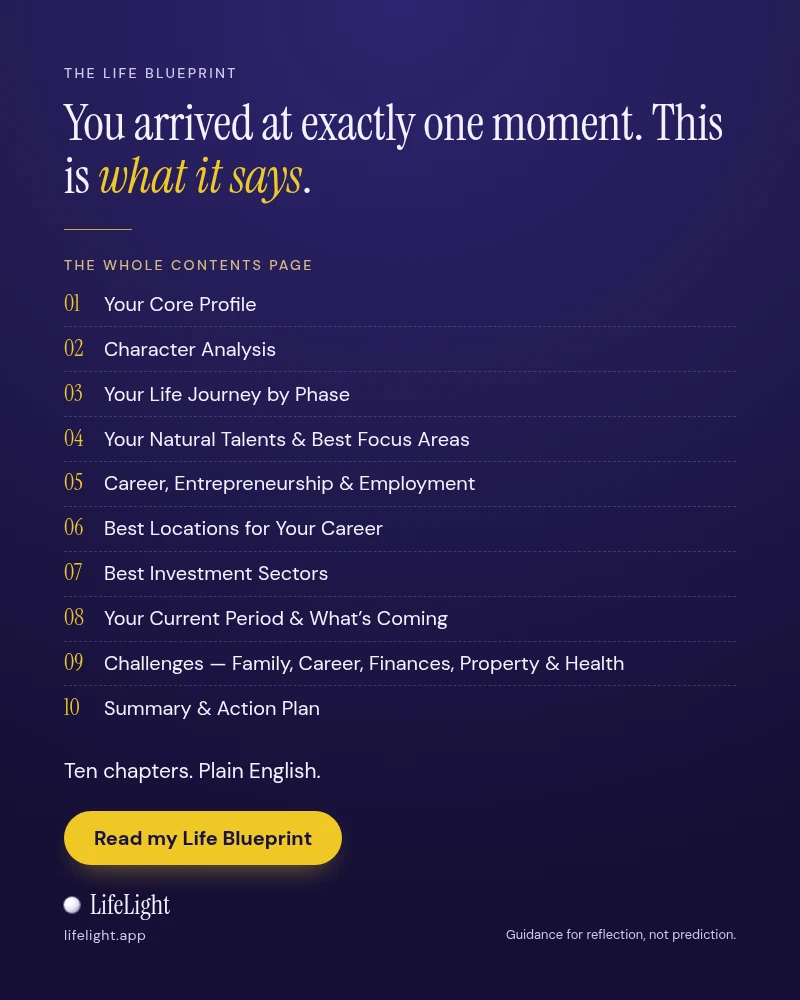
A Life Blueprint is ten chapters on what you're built for, and when, computed from the elemental energies present when you were born. Computed, not guessed. It does not rank how useful you are, and it does not say a talent will be rewarded. It describes the grain, and the season you're standing in now — which is close to Zhuangzi's own answer, now high and now low, in step with the time.
It is written in plain English and delivered in minutes. Guidance for reflection, not prediction.
Ten chapters on what you're built for, and when. Not what you are useful for.
Source: Zhuangzi, chapter 4 (人間世), paragraphs 6 and 9, and chapter 20 (山木), paragraph 1. Quotations from James Legge's translation, The Texts of Taoism (1891), public domain: part 1 and part 2. Other passages are our own retelling.