This Diwali, study the hand that writes in the new account book
· 5 min read · Share this article
When the new book opens, are you still writing in the old hand?
A New Account Book, and the Same Hand That Writes in It
The book is red, long and narrow, and the first page is empty. On Diwali, in shops and family offices across Gujarat, a merchant sets a new account book on the altar beside images of Lakshmi, Ganesha and Sharda. Last year's ledger is closed. The new one is marked on its first page with two words, Shubh Labh, auspicious gain, before a single figure goes in.
The ritual is called Chopda Pujan, the worship of the account book. It is one of the quieter customs of the festival of lights. It is also the most honest picture we know of what a new beginning with money is supposed to feel like.
A clean page, once a year
Chopda means a book of accounts. In Rajasthan, Gujarat and Maharashtra, Diwali has long marked the start of a new business year, and the same ceremony goes by other names elsewhere: Bahi Khata in the north, Sharda Puja or Muhurat Pujan in other places (Times Now). Britannica records that on the fourth day of the festival, the first day of Karttika and the start of the new year in the Vikrama calendar, merchants perform ceremonies and open new account books.
The custom has survived the computer. In Ahmedabad, the Indian Express found the books still worshipped on Diwali and written in for the first time on Labh Pancham, five days later. Many families now place a laptop on the altar instead of a ledger.
Customs differ by region and by family, and we describe them from the outside. What they share is the gesture. The old year is closed with thanks, and the new one is opened with care.
Lakshmi at the open door
Around that gesture sits the rest of the festival. Lakshmi is the goddess of good fortune and abundance, and on the new moon night of Diwali small oil lamps are lit in rows to invite her presence (Britannica). On Dhanteras, the first of the five days, homes are cleaned. Doors and windows are left open in the hope that she finds her way inside, and in many homes her footprints are painted beside the doorway (Britannica).
Clean the house, light the lamps, open the door. Then open a new book.
It is a season built for beginning again with money, which makes it a good moment to look at the one thing that never gets a new page.
What the ledger cannot hold
A ledger is a careful record of what came in and what went out. It is silent on why. It shows the purchase, and not the second visit to the shop that settled it. It shows the loan to a cousin and not how fast the yes arrived, the sum left untouched for three years and not the reason nobody could decide what it was for.
The new book will be written by the same hand as the old one. On the first morning of the year the page is clean, and by the second month the old patterns are back in the columns. They never lived in the book.
Morgan Housel made a version of this case in his 2020 book, The Psychology of Money. His publisher's summary puts it in two lines: "Doing well with money isn't necessarily about what you know. It's about how you behave." We borrow his phrase in its plainest sense — the way one particular person decides with money. We have no connection to either.
Three entries that never reach the page
Every way of deciding leaves the same three gaps in the book.
The decision on repeat. Most people make one money decision over and over, in different clothes. The generous yes before the month is checked. The purchase put off until the moment has passed. The column records each one separately, so the pattern never shows.
The speed. Some people decide in an afternoon. Others need a season, and neither is a fault. The cost comes when a fast decider meets a slow decision, or the other way round, and nobody notices which kind it was.
What it is for. For one person money is safety. For another it is fuel, or freedom, or proof. Two people can keep identical books and mean different things by every line, which is why the same choice sits well with one of them and is regretted by the other.
That is what we mean by a psychology of money. Not a theory. A pattern, with a name.
A different tradition, the same season
The Money Blueprint draws on other ancient eastern traditions, reading the elemental energies present when you were born as a temperament.
The two meet only in the season. Diwali is a time when many families turn a page on money, and a turned page is a good moment to look at the hand that writes on it.
The first page
A Money Blueprint describes that hand. Every budgeting app you have tried was reading what you spent. This reads the hour you arrived, and the temperament you brought with you.
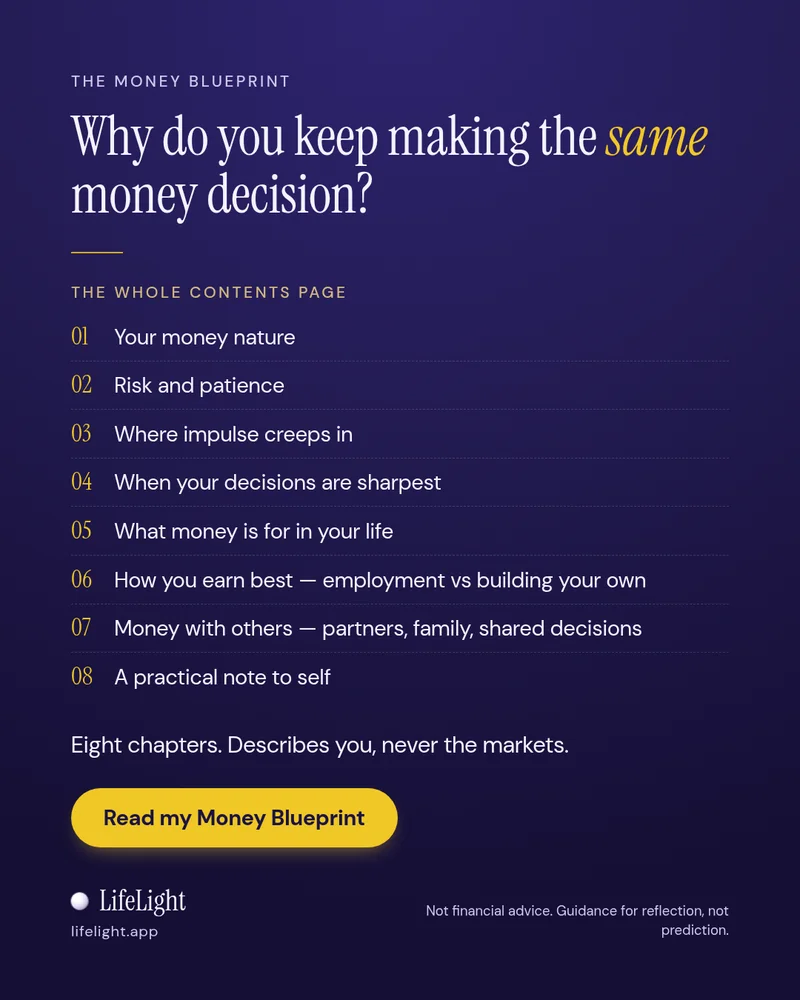
It is eight chapters on how you are with money: your money nature, how you hold risk and patience, where impulse creeps in, and the years in this decade when your judgement tends to be steadiest. Computed, not guessed. It describes you, never the markets, and it carries no tips, no figures and no forecasts.
It does not tell you what to write in the new book, and it does not promise the year will add up. Not financial advice. Guidance for reflection, not prediction.
What it gives you is the pattern, named plainly, before the first entry. The choice stays yours.
Eight chapters on how you decide with money, computed from your date, your hour and your place.
Sources: Encyclopaedia Britannica, "Diwali" and "Lakshmi"; Times Now, "Samvat 2077" (2020); The Indian Express, "Chopda Pujan" (Ahmedabad); Moneycontrol, "Diwali Chopda Puja" (2025). Quotation from the Harriman House summary of Morgan Housel, The Psychology of Money (2020). LifeLight has no affiliation with the author or publisher.