The LifeLight Blog
Was your life settled the moment you were born?
· 4 min read
Is a fixed chart the same as a fixed life?
There Must Be a Difference: The Last Line of the Butterfly Dream
A man wakes up. A moment ago he was a butterfly, drifting about in the air, pleased with itself and with no idea that it was anyone in particular. Now he is lying still, heavy and solid, and he is Zhuang Zhou again.
For a while he cannot say which way round it was. This is the closing story of chapter 2 of the Zhuangzi, written more than two thousand years ago, and it is probably the best-known passage in the book. It is also one of the most often cut short.
The dream, as Zhuangzi wrote it
Here is the waking, in James Legge's 1891 translation. Legge spells Zhuang Zhou's name Kwang Kâu.
"Suddenly I awoke, and was myself again, the veritable Kâu. I did not know whether it had formerly been Kâu dreaming that he was a butterfly, or it was now a butterfly dreaming that it was Kâu. But between Kâu and a butterfly there must be a difference."
One more short sentence follows. In our own rendering, it says that this is what is called the changing of things.
Most retellings stop at the doubt. The text does not.
Two camps, one dream
The doubt is the part that travels. It suits two popular ideas that point in opposite directions. The first says a true self is buried somewhere under the years, waiting to be dug up by anyone patient enough to keep digging. The second says the self is a story we tell. There is nothing underneath to find.
Both camps borrow the butterfly. But the passage does not end on the doubt. It ends on a distinction.
There must be a difference. A man is not a butterfly, and Zhuangzi says so in as many words. He is not claiming the self is unreal. He is claiming it is real, and that it does not stay in one form.
So the passage holds together two things we usually set against each other. Something stays. Something moves.
Three people with one name
Picture three people with one name. The child who could spend a whole afternoon on one beetle. The student who was certain, at nineteen, which life she wanted and in which city. The person reading this sentence now.
There is a difference between them, and it would be strange to pretend otherwise. There is also a thread that runs through all three, and it would be equally strange to pretend that away. Seen this way, a life arrives in stages rather than as one smooth line, and each stage carries the last one inside it — the way the man on the bed still carries the dream.
That is the line most retellings cut. It is also the one worth keeping.
The fair objection
This story raises an objection for anyone who reads a life from the moment of birth. If the chart cannot change, it can look as though the life cannot either. The objection is fair. It deserves a straight answer rather than a soft one.
A deterministic engine does the arithmetic, so the same birth moment always produces the same chart. That part does not move. Computed, not guessed.
But the chart is not only a portrait of one instant. It also describes how the elemental energies present when you were born move and change across the length of a life, in ten-year seasons. That is why a Life Blueprint can map those seasons end to end, and name the one you're standing in now.
So the reading holds two things, as the dream does: a fixed starting point, and a moving season. A third thing is not in the chart at all, and that is what you choose to do. The reading describes patterns, tendencies and timing. The choices remain yours.
A fixed chart is not a fixed life. That is a rule in how it is written, not a promise about it.
Waking, solid, surprised
Back to the man on the bed. He does not decide the butterfly was nothing, and he does not decide he was never Zhou. He lies there, solid and surprised, and allows that there must be a difference.
The butterfly is Zhuangzi's image, and reading it alongside a birth chart is ours, not the tradition's. Zhuangzi was not describing charts. Still, the shape of his answer is close to the shape of the reading: one starting point that stays put, and a life that does not stay in one form.
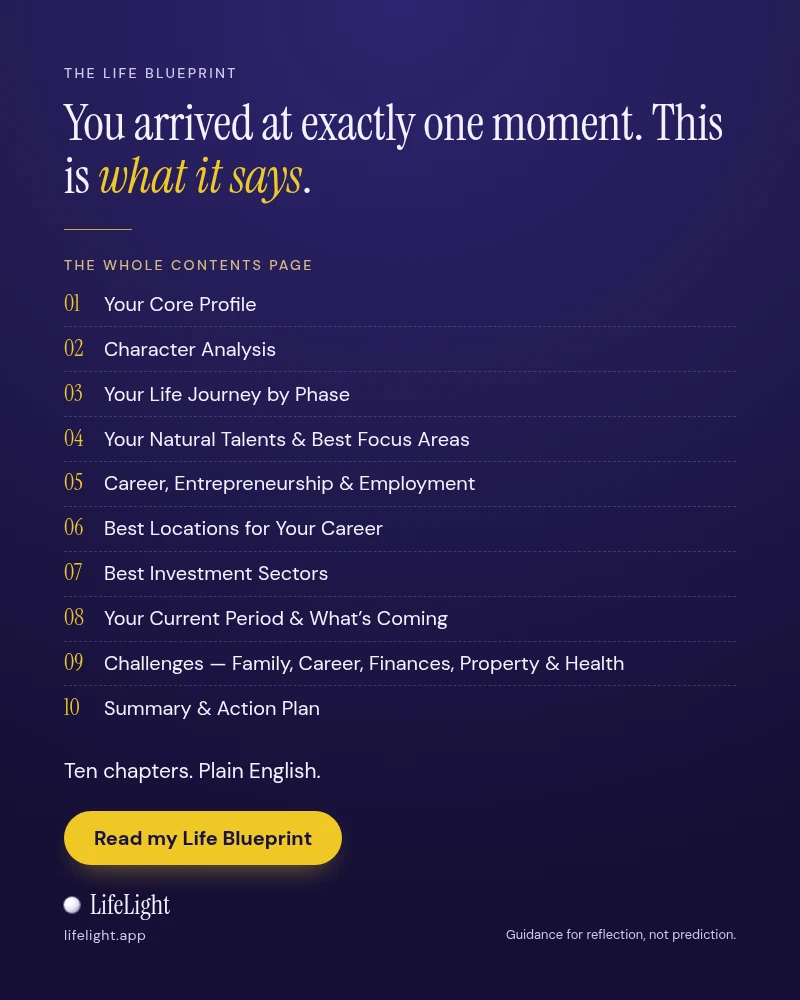
A Life Blueprint is ten chapters on what you're built for, and when, computed from your date, your hour and your place. It reads the map you were born with alongside the season you're standing in now. It does not tell you who to become, and it does not decide anything on your behalf.
What it gives you is a description of the starting point and the season, in plain English. Guidance for reflection, not prediction.
The map you were born with, and the season you're standing in now. Ten chapters, computed from your exact birth moment.
Source: Zhuangzi, chapter 2 (齊物論), closing paragraph. Quotation from James Legge's translation, The Texts of Taoism (1891), public domain. The opening scene and the closing sentence of the passage are our own retelling.